Cleared London: Recycling and Sustainability Commitments
 At Cleared London we take an active role in reducing waste and lowering carbon emissions across the capital. Our ClearedLondon teams work alongside local borough systems to ensure that clear, practical recycling activity complements council schemes for paper, glass, food and textile separation. We publish an annual recycling percentage target to drive continuous improvement and transparency, and we track progress across every project we deliver.
Our short-term target is to achieve a recycling rate of 70% of all recoverable materials from client clearances by 2030, with incremental milestones every year. This target covers reuse, repair, donation and recycling streams rather than just diversion from landfill, because reuse is often the highest-value environmental outcome. We prioritise redistribution where possible and apply robust sorting at source to meet that goal.
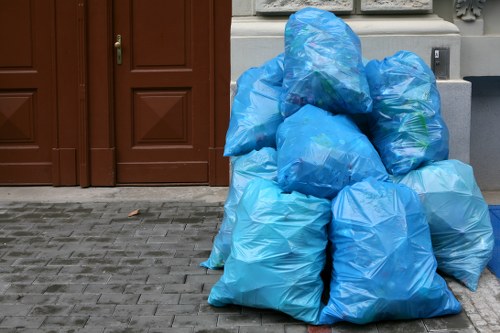 Across central and inner London boroughs our teams are trained to match each local authority's approach to waste separation: whether the client site is in Hackney with a two-stream dry recycling system, Camden’s mixed collections and food waste scheme, or Kingston’s focus on separate glass and textiles. This flexibility means Cleared London sustainability work is aligned with the relevant council above-and-below kerb policies so materials enter the correct local transfer stream.
Local transfer stations and logistics
We operate with a network of vetted local transfer stations and consolidation hubs to keep journeys short and maximise material capture. Each transfer station partner is selected for strict environmental standards, traceable tonnage reporting and compliance with waste transfer notes. Reducing haul distances reduces emissions and costs, and it improves the likelihood that materials will be processed correctly by the boroughs’ recycling infrastructure.
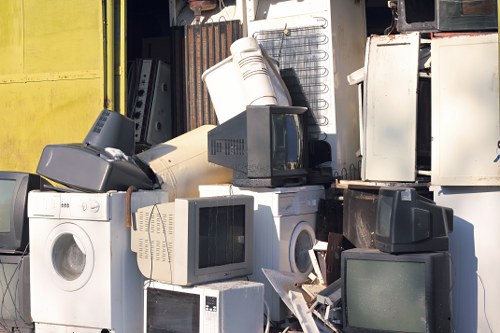 Operationally, Cleared London recycling collections use route optimisation software and timed consolidation runs to fill vehicles efficiently before they travel to transfer stations. This reduces empty running and ensures we deliver paper, card, glass, WEEE and bulky items to the best local processing facilities. For items suitable for repair or resale, we divert to partner reuse centres rather than recycling, increasing material life and lowering embodied carbon.
We maintain strong documentation at every step: waste transfer notes, segregation logs and annual volumes by material stream. These records support client reporting and allow us to measure against the Cleared London recycling targets we set each year.
Partnerships with charities and social value
Cleared London works with a range of local charities and social enterprises to maximise reuse. Our charity partners accept furniture, working white goods, textiles and electronics for redistribution across London communities. Example partners include community reuse centres, employment charities that refurbish items and organisations supporting upcycling initiatives. Key benefits of these partnerships include:
- Increased reuse—keeping functional items in circulation
- Social value—supporting training and job creation through refurbishment programmes
- Transparent traceability—clear records of donations and redistribution
We actively prioritise local redistribution to borough-based charities so that cleared goods support neighbourhood needs rather than being transported large distances.
Low-carbon vans and fleet strategy
 Our fleet strategy is central to Cleared London sustainability and Cleared London recycling delivery. We increasingly use low-emission vehicles — full electric vans, plug-in hybrids for longer runs and a growing number of cargo e-bikes for central London collections — to reduce scope 1 emissions. Our aim is to transition 60% of all urban collection mileage to zero-tailpipe vehicles by 2028.
 Alongside cleaner vehicles we reduce carbon through logistical measures: consolidated pick-ups, off-peak collections to avoid congestion, and shared consolidation hubs. Drivers receive eco-driving and materials-segregation training so that every stop contributes to the recycling percentage target and to lower fuel use. Technology, training and electric vehicles together form the backbone of our low-carbon approach.
In summary, Cleared London sustainability work blends ambitious recycling targets, local transfer station partnerships, charity redistribution channels and a low-carbon fleet. We adapt to borough-specific separation rules, document material flows, and prioritise reuse where it delivers the greatest environmental benefit. By combining strong operational standards with community partnerships, ClearedLondon strives to reduce landfill, increase reuse and drive down the emissions associated with clearances across the capital.